Architects, designers, and planners use architect scale rulers in their work every day. Here are 3 ways that an architect scale ruler can help a homeowner like you, too.
Plan a new arrangement of furniture in your living room. Whether you just
Kitchen Design
moved in, or you just want to make a fresh arrangement of your furniture, you can start with a piece of paper and an architect scale ruler to see if your plan will actually fit the way you want it to fit.
Design a new kitchen in your home. The best way to start is to find a picture of a kitchen in a magazine, then see if the components will fit into your space. An architect ruler will let you make precise measurements in your drawings of different kitchen designs.
Design a garden in your back yard. If your space is limited, the architect ruler will help you to make the best of the space you have. You may discover that you don’t need to buy as many tomato plants, or pepper plants.
Most people don’t need an architect scale ruler, but for those who do need one, this is for
Architect At Work
you.
This ruler will make your job easier, so you can obtain measurements off the drawing without having to convert from the drawing’s actual measurements. You can use the 12″ size in the office. Or, you can take the 6″ pocket version with you into the field. For larger drawings, you can use the retractable pocket architect tape. This will work either in the field, or the office.
Everyone knows how to use an inch ruler. And most people know how to use a metric ruler. It doesn’t matter that there are 2.54 centimeters per inch. A centimeter is a centimeter. But, if you remember when you saw an architect scale ruler for the first time, you will agree that the scales are a
Architect Working on Plans
mystery. There are several scales on the same ruler. There are (1/8, ¼), (½, 1), (3/8, 3/4), (3, 1½). What do these scales mean?
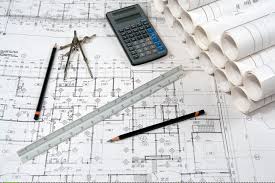
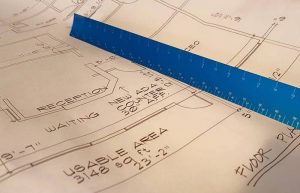
Let’s bring in a blueprint. Now you need that architect scale ruler to measure the size of objects on the blueprint. Since the objects are drawn at a scale of the original size, you need to match up that scale with the corresponding scale on the ruler.
How do you choose the correct scale? Look in the bottom right corner of the blueprint. There is a box of useful information. It has the name of the drawing, the date drawn, the architect name, and the scale that it was drawn with. If the scale is 1/8, then every 1/8″ on the paper represents 1 foot (or 1 mile, etc) in reality. So you would use the 1/8 scale on the architect ruler. Where the ruler says 16, the reality measurement is 16 feet (or 16 miles, etc). It doesn’t matter right now that the measurement on the paper is 2 inches. That’s too much information. Let the ruler do the work for you.
Congratulate yourself. Now you can consider yourself proficient at using an architect scale ruler.
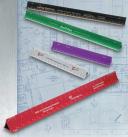
A good way to advertise your company is putting your logo on useful tools. Then give those tools to your customers or contacts. A unique measuring tool is an architect scale ruler. If you are in the building or remodeling business, this form of advertising is taylor-made for you. It will last forever, and so will your logo.
Your clients and customers can use it for:
Reading the blueprints for building a new house.
Reading the remodeling plans for an addition
Making paper models of furniture to put in a new house.
Choosing the right size hot tub or Jacuzzi to put in a new addition.
Seeing if your present furniture will fit in your new house.
An architect scale ruler can come in many sizes and gradations. For now, let’s keep it simple, just to get started. Here is how these handy rulers can make reading a blueprint very easy.
First, look in the title block of the blueprint, which is usually located in the bottom right hand corner. It will tell you which scale to use. If it says: 1/4″=1′, then you will be using the 1/4 scale on the architect ruler. That means, 1/4″ on the blueprint represents 1 foot in the actual size of the object. If it says: 1/8″=1′, then you will be using the 1/8 scale on the architect ruler. Many other scales are used, because of the size limits of the paper the drawing is put on, and the actual size of the object or building or landscape.
Now, simply use the correct scale to measure the actual size of each part of the drawing.
Fine-tuning: You will notice that the zero mark is not the first mark on the scale. It is preceded by some very small gradations. These gradations could have been printed on the entire scale, but that would be very hard on the eyes. Let’s say you are measuring a line that is between 5 and 6 units. Now put the 5 mark on one end of the line. Look now to the other end of the line where it lines up with the very small gradations. Here you can read how much more than 5 units the line is.
If this sounds a little confusing, just give it a try, and you will see how easily you will catch on.
Architect scale rulers are a specialty item. Not everyone needs one. So here is a list of people and businesses who really need and use them. For them, Architect scale rulers are a necessity. This gives you a great way to advertise your business to them.
Floor tile retailers and wholesalers
Architects
Draftsmen
Builders
Carpenters
Designers
Electricians
HVAC installers
Engineers
Draftsmen
Housing developers
City planners
Painting contractors
Ceiling tile installers and retailers and wholesalers
To use an architect scale ruler is not an easy task. Since these rulers come in many configurations, you first must know which scale to use. Here are the basic steps:
Find the scale needed in the Title Block of the blueprint. If it says 1/8″ equals 1 foot, then go to the next step.
Use the right scale. 1/8, 1/4, etc. The 1/8 scale means that the markings are 1/8″ apart. The 1/4 scale means that the markings are 1/4″ apart.
Lay the scale on the blueprint and measure your object. If you are using the 1/8 scale, and the object is at mark 5 on the scale, then it is 5 feet long.
Accuracy. If the object is not an even number of markings on your scale, you can get the accurate measurement by using the fine markings before the zero mark. Say the object is between 5 and 6 on your scale. Just slide the final mark (5 in this case) to the end of the object. Then you can read the answer as 5 marks plus whatever the object lines up with in the fine markings below the zero mark.
If your clients use an architect scale ruler, you can promote your business in this unusual way. Give them this special ruler with your corporate logo imprinted on it. Your logo will last as long as your client uses an architect scale ruler. Who uses one of these?